NIGHT


We have all heard the story of Anne Frank, which familiarized us with the atrocities on jews in Nazi Germany. In the ranks of those war time classics, is NIGHT by Elie Wiesel. This little known Nobel Prize Winning book is a horryfying account of a time when the world watched the cruelty as silent spectators. 

 Elie Wiesel, author and narrator of NIGHT, a true story of the Holocaust, managed to live through Hitler’s criminal atrocities and write down his experiences in the concentration camps. He begins his dramatic stories in 1941 in the small city of Sighet located in Transylvania. Elie, a young boy , along with his family of four, found them selves bombarded and split up by the Hitler lead Germans and deported to nearby concentration camps. Throughout the book, Wiesel explains his experiences with the belief in God, what provides for him and others a will to live, and the important realities of life. 

An important theme and aspect of Night to me is how beliefs and ways of thinking can change during a person’s life and how these ways change throughout the book. It is easy to understand that such an awful experience to a young child can change his ways of thinking, especially about life in general. How can seeing so many people die in such harsh ways not make a child around the age of fifteen see life as unfair and worthless?  As I read through the book, I slowly began to realize, due to Wiesel’s amazing descriptions and ability to allow the reader to feel how he was felt, how a person could go through this drastic change in faith. Elie begins his horrible journey with a complete faith in God, and an amazing will to learn as much as possible about his own religion. He even goes against his father’s rules to find a person, Moshe the Beadle, which can help him accomplish this. However, when in the summer of 1944 he is deported to Aushwitz and his encounters begin to add up, he slowly starts to question the truths about God and even God’s own existence. Young Elie first begins to question God when he states, “What are You, my God, compared to this afflicted crowd…What does Your Greatness mean, Lord of the universe…” As the story proceeds, he goes on to explain how he was “the accuser,” and “God the accused…terribly alone in a world without God” .In another instance he imagines God as the one on the podium, being hung, instead of the Jews. Furthermore, Elie even begins going against his religion’s rituals and does not fast during the proper week. He is forced to believe that the only way he could live is not with God’s help, but with his own gut feelings. 

After reading and examining Wiesel’s written work, I definitely began to understand young Elie’s reasoning on religion, and even understood how he could almost put more faith and trust in to Hitler due to Hitler’s ability to keep a promise, even though Hitler’s loyalty is what ultimately lead to millions of deaths. Without Wiesel’s incorporation of dialogue from characters and his own thoughts of religion, I do not think I could have been so persuaded

 Now that Elie’s will to live was not under his faith in God, another theme arises in his search for a will to live and survive.. I feel like Night stands for the only actual good part of their imprisonment at the concentration camps. Sleep was always a necessity and need for the imprisoned Jews. It was part of the hope for survival; therefore, a will to live. Next, being a child, his initial basis and reason for survival was because he is never separated from his father. Being able to stay in close quarters with his father allows him to remain strong and have a helping hand to fall back on. However, as the story progresses, his father begins to become ill and Elie is obligated to not only fight for his own survival, but also his father’s. This situation begins with Elie’s fight to stay with his dad, but turns out to become his will to survive. Instead of placing his mind on surviving through Hitler’s wishes, he puts his thoughts and energy on keeping his father alive, which ultimately leads to his own survival. To further create this theme, Wiesel introduces two characters that portray the extents people will go to in order to survive. Nearing the end of the novel, the Jews are forced to run for forty-two miles to Gleitwitz. During this expedition, Elie watches as two characters, the Rabbi and his son, lose each other due to the son running away to drop the dead weight of his old father. At first, Elie is appalled of this nature, but slowly begins to realize the same with his own father.
 
Another huge example and theme that Wiesel emphasizes as a will to live is the fight for food throughout the account. Inside the concentration camps, the prisoners are rationed very small amounts of food, if not deprived. Young Elie along with all of the other prisoners yearns for as much soup, bread, and water as possible. The imprisonment begins with people wanting to aid in the survival of other prisoners with the sharing of their personal supplies. It was their need for survival. However, as time passes, Elie witnesses many horrible accounts of almost animal like behavior. From Meir beating and stealing from his father on the train to masses of people killing each other to obtain the last bite of bread, Elie could not believe how such a situation could change the actions of civilized people. 

 With the shock of feeling it would be okay to let his father die for his own survival to the realizations of how people can change under intense circumstances, other themes are incorporated when Elie begins to find many astonishments about the truths, realities, and harshness of life. Along with these realizations, Elie most importantly finds out the truth of death, and at only the young age of fifteen. Elie witnesses more deaths than most people could even imagine. He not only sees corpses lying in snow and being smothered by other dying people, but he also witnesses the brutal death of innocent people through cremation, hangings, starvation, beatings, and even pure sadness. He also observes how and why people could not maintain the will to live, even though he is able to maintain it the whole time. He learns about inhumanity through the actions of the Germans. This goes right along with death, but he could not believe how he and the others were treated like animals. At one point, Elie states how he felt like “cattle or merchandise” as the prisoners were lined up, pointed at, and “selected.” 

 
In the preface to the book, Robert Brown describes how some people either do not believe in the horrific mass killing or do not care about it. Night was created to give an account that these awful events did occur, and Wiesel does a great job to get the effectiveness of the event across to his readers. To manage this, he is able to include characters like his father, who represents Elie’s main hope of survival and will to live; Madam Schachter, who represents the scary, psychological, but honest aspects of the event; and Elie’s friends (the brothers), who represent the need to work together; which all are apparent themes of the novel. Wiesel also used these characters to show how others were feeling, enabling readers to understand that everyone maintained different feelings and beliefs of the situation. Because of the ability to incorporate all of these measures, Wiesel intended for all people to be able to read and learn from his experiences. Sometimes people can be ignorant to the aspects, feelings, and events in life. Wiesel created this book so that for years to come, people will be able to believe and understand the cruelty, harshness, and reality not only of the Holocaust, but other events that could possibly occur in life.

SYBIL


I have been ignoring my book blog for quite a while now, despite reading a lot of books lately. My initial aplogies to my book blog. I want to make up to you by making you feel a little special this year and dressing you up suitably with a lot more posts and a better look.

So, coming to the review part. I've read a few good books in the last four months. I think it is high time I posted a review on those. I choose the most recent book I read, for my review.

My mother does not read. Anything. Even a newspaper. And not certainly English. Hence I was surprised when she told me about this amazing book she's read many many years ago. SYBIL. I kept hearing on and off about it from her and decided to pick it up for my collection. After many trips to book stores and being told that the book is out of stock, I finally managed to find it at Odyssey, about a month back. And I started reading it with immediate effect. I am glad I did.

SYBIL is a book published in 1973, written by Flora Rheta Schreiber about a true-life story of a woman suffering from multiple personality disorder. I had never heard of the book, and until I finished reading it, I didnt know that SYBIL is actually a pseudonym of a woman named Shirley Arden Mason. Hers is perhaps the most famous case of multiple personality disorder. The pseudonym was given to protect her privacy.

SYBIL, was born on 25th January, 1923 in Minnesota. She had a history of blackouts and emotional breakouts, and finally entered psychotherapy with Dr Cornelia Wilbur a Freudian Psychiatrist. Their sessions together form the basis for this book and its narrative. After extensive therapy, it is discovered that SYBIL has 16 different personalities, which disassociate themselves from the central personality. The biggest task is to integrate these disassociated ones with the central one in order to have SYBIL lead a normal life. The book is based on the therapy, treatment and triumph of this woman to overcome a mental disability, which would take several years of determination and sometimes hopelessness. 

It was a shocking read for me, in a way scary, when I thought what would I do if I were in that situation. Would I recover from it? How would I feel when unknown people come up to me and claim to know me? It was an eerie read, but surely engrossing.

I find it difficult to write a review on this true-life story. I would recommend it as a must read, though.  I found it hard to put down and the case of 16 different personalities to a woman are perplexing and baffling. It is scary, but still, it is definitely worth a read.


Instead of giving just the excerpts, I'll attach a sketch of the 16 personalities of SYBIL ISABEL DORSETT. 

Sybil Isabel Dorsett (1923): a depleted person; the waking self.

Victoria Antoinette Scharleau(1926): nicknamed Vicky; a self-assured, sophisticated, attractive blonde; the memory trace of Sybil's selves.

Peggy Lou Baldwin (1926): an assertive, enthusiastic, and often angry pixie with a pug nose, a Dutch haircut, and a mischievous smile.

Peggy Ann Baldwin (1926): a counterpart of Peggy Lou with similar physical characteristics; she is more often fearful than angry.

Mary Lucinda Saunders Dorsett (1933): a thoughtful, contemplative, maternal, homeloving person; she is plump and has long dark-brown hair parted on the side.

Marcia Lynn Dorsett (1927): last name sometimes Baldwin; a writer and painter; extremely emotional; she has a shield-shaped face, gray eyes, and brown hair parted on the side.

Vanessa Gail Dorsett (1935): intensely dramatic and extremely attractive; a tall redhead with a willowy figure, light brown eyes, and an expressive oval face.

Mike Dorsett (1928): one of Sybil's two male selves; a builder and a carpenter, he has olive skin, dark hair, and brown eyes.

Sid Dorsett (1928): one of Sybil's two male selves; a carpenter and a general handyman; he has fair skin, dark hair, and blue eyes.

Nancy Lou Ann Baldwin (date undetermined): interested in politics as fulfillment of biblical prophecy and intensely afraid of Roman Catholics; fey; her physical characteristics resemble those of the Peggys.

Sybil Ann Dorsett (1928): listless to the point of neurasthenia; pale and timid with ash-blonde hair, an oval face, and a straight nose.

Ruthie Dorsett (date undetermined): a baby; one of the lesser developed selves.

Clara Dorsett (date undetermined): intensely religious; highly critical of the waking Sybil.

Helen Dorsett (1929): intensely afraid but determined to achieve fulfillment; she has light brown hair, hazel eyes, a straight nose, and thin lips.

Marjorie Dorsett (1928): serene, vivacious, and quick to laugh; a tease; a small, willowy brunette with fair skin and a pug nose.

The Blonde (1946): nameless; a perpetual teenager; has blonde curly hair and a lilting voice.

The New Sybil (1965): the seventeenth self; an amalgam of the other sixteen selves.


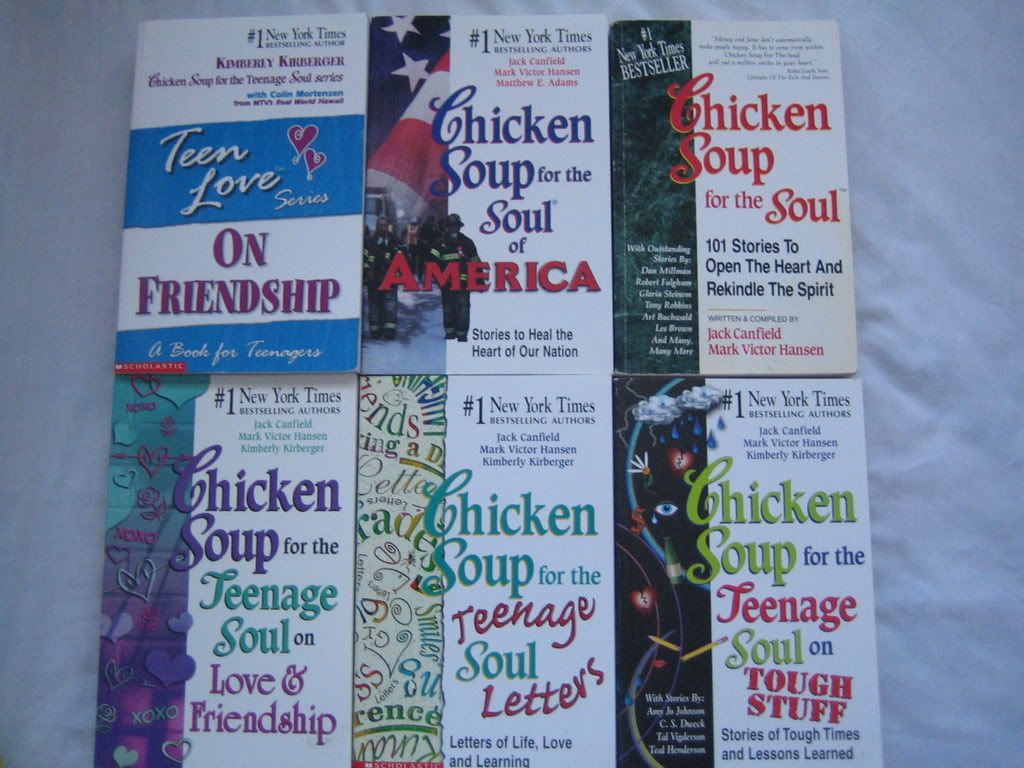
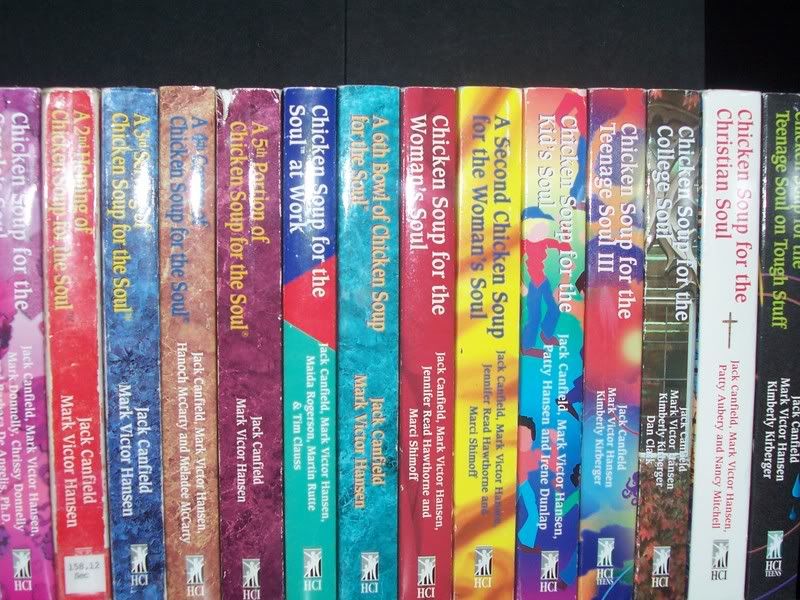
Chicken Soup for the Soul series


I got my first Chicken soup for the soul book by Jack Canfield and Mark Victor Hansen, as a gift over 8 years ago. Even now, Chicken Soup series of books continue to draw me to bookstores. I may not pick up any other book that i desperately want, but if I find a Chicken Soup title, I hardly give it a second thought.

I have 3 books to my collection. Each is a thick book of powerful, morale boosting true stories of people coming from all walks of life. Each has a very inspiring and soothing tale to tell, and each story touches and reaches out to different people.

When I was given the first book, I had no clue as to why the title was so wierd. Being a vegetarian, I thought it was a gross thing to name a book that way. Back then as a 11 yr old, I didn't realise the importance of Chicken Soup for good health as they have a soothing effect on the body. Chicken Soup for the soul does the same. Instead of soothing your body, it soothes your soul.

Every story from these books is like a mountain of inspiration. It acts as a balm to heal old wounds, but that of the heart. It's about opening up your heart to other's experiences and being affected by it. It's to have your spirit rekindled with hope and love. It's to give you the courage to go after your dreams.

And all these stories I read were so simple and yet beautiful. These are stories that I think people want to hear about, no matter their nationality, age or gender. These stories carry with them encouraging and inspiring messages that I think most people will understand and can resonate with.

Chicken Soup for the Teenage Soul was one book I liked in particular. It helped me a great deal in my latter teen years to cope with many diffuculties. My trivialities seemed to resolve at once. I knew I wasnt the only person in the world going through that troublesome adoloscent phase. I connected with others like me and knew at once, that life, will be OKAY.


Quite often, my eyes would suddenly well up in tears as I read one great story, and before I could have the chance to dry up, the next story brought on another bout of tears.
Each story is short, easy to read, digestible and filled with goodness
I'm sure glad the authors Jack Canfield and Mark Victor Hansen didn't give up the idea of publishing their first Chicken Soup for the Soul book. Their story of creating and eventually publishing this book was in itself an inspiring story to be told.

After 3 long years of hard work to put together the book and rejections from 140 publishers, their vision to uplift humanity through this book finally came through. Chicken Soup for the Soul was finally published under Health Communications, Inc. The president of the company, Peter Vegso caught the vision of the authors and the spirit of the book and agreed to publish it.
On June 28, 1993, Chicken Soup for the Soul was launched and the rest was history. These books have gone on to become bestsellers for many titles. With over 80 million of copies of Chicken Soup books sold all over the world, it made publishing history.

Currently, I am reading Chicken Soup for the Writer's Soul. For someone who's had a life long dream to make the world a better place, with the pen, it has started out to be a great read. I expected a lot from this book, and it has gone much further ahead of my expectations. Thus far.

In the end, I suggest a Chicken Soup title for everyone. They have a book, a story for everyone. And I guarantee you, you'll find your life reflected in many of the stories that you read.


John Wright's Indian Summers


As My blog description suggests that they would contain more stuff about Raikkonen, Books, Sports and ME... it has been more of the ME and less of other elements. My beloved Raikkonen hasn't been written about enough either. So I thought, let me write something about the books I'm reading/have read.
These days I'm a bit tied up with studies, so I guess I will write about one of the nicest books I've read in the recent times.

John Wright's Indian Summers is an enthralling read for all the Indian cricket aficionados. Indian cricket's first foreign coach, the New Zealander gives vivid details of his long and successful stint at the helm of cricketing world's most star packed team. Of course, after the World Cup '07 we all label them more as fading stars, but during his time the ream flourished and reached dizzying heights. New stars were born and a new confidence along with team spirit was seen in quite a while.

The book describes Wright's appointment to the job and he tells us about his experience from the moment he landed to the moment he took off. The Cricketing board's meetings over tea, the ruckus that the meetings would turn out to be and above all, we get to see the apathy of the cricket board. Most of it we already know, but much is said, albeit between the lines.

The most fascinating thing for me in the book was the discovery of John Wright as the-not-so-quiet-coach. While in the limelight of things, he never spoke out much to the press. He kept to himself and his job and we always thought here was a soft coach we have who may buckle under the pressure of being in an unknown place. But as one read the book, we get to know the reprimanding side of the coach, who'd settle for nothing less than the best from the boys. He mentions many not-so-dirty-incidents of the dressing room that though make interesting read, fail to lift eyebrows. Mind you. NO NAMES ARE MENTIONED.

Nevertheless, it is a very good read and worth spending money on if you would like to see the Indian cricketing scene from the eyes of a good coach. It is an account of an honest man, who did much for Indian Cricket (read trainers, physio and proper equipments and facilities, previously not available). This one isn't sensational but definitely gets you a few laughs. Here are some excerpts to help you decide on reading it.

ON TEAM SELECTIONS:
"The first six or seven selections were straightforward. But when it got down to the marginal selections, those last three or four spots that determine the balance of the team and your ability to develop new players, the zonal factor kicked in and things would get interesting," he wrote.
"It was easy to tell when selectors had come to a meeting with an agenda... If their boys weren't picked, they tended to cross their arms, clam up and take no further part in the meeting."


Care to guess who Wright's talking about here?

"In Jodhpur, a guy with the biggest diamond ear-studs I'd ever seen wandered into our viewing area as if it was his private box. I went nuts demanding to know who the hell he was and, more to the point, who the hell he thought he was. The answer to both questions was that he was India's biggest beer baron." [page 43] - it's the one and only Vijay Mallya!


The Experience that was India...
"People would stop me in the street to thank for being 'our' coach. It was humbling, but also guilt-inducing, because many of those who thanked me for doing a well-paid job that I loved led lives of day-to-day struggle. The gratitude and support I received from ordinary Indians was the most positive force I've ever encountered, in that it simultaneously lifted me and kept my feet on the ground." [page 70]